How to Choose a Luggage Set: Pieces and Sizes
A good luggage set has the pieces and sizes you’ll use regularly, with at least one case that fits your usual trip. Start with a carry-on and a checked bag if you take varied trips; choose 3 pieces if you need small, medium and large options.
On this page (8 sections)
- What makes a good luggage set?
- How many pieces should a luggage set have?
- Which suitcase sizes should your set include?
- How do you compare the cases in a set?
- How much storage space will a set need?
- Which kind of luggage set fits your travel pattern?
- How to choose a luggage set: a quick checklist
- Which luggage set should you choose?
A good luggage set has the pieces and sizes you’ll use regularly, with at least one case that fits your usual trip. Start with a carry-on and a checked bag if you take varied trips; choose 3 pieces if you need small, medium and large options.
Think about your most common trip, how much you pack and where you’ll store unused cases. A set is useful when its extra sizes fill real needs, not just because it includes more bags.
If you’re unsure whether buying a set makes sense, read Are Luggage Sets Worth It?. For a wider selection, see our best luggage sets guide.
What makes a good luggage set?
A good luggage set matches your travel habits and gives each included case a purpose. Before comparing colors or features, decide which sizes you’ll actually take on trips.
For a weekend away, a carry-on may be enough. Longer trips or trips that need more clothing may call for a checked case, while a range of trip lengths can make a three-size set useful.
Set names don’t tell you whether the cases will fit your airline, closet or car trunk. Compare outside dimensions, including wheels and handles when provided, and check the measurements of each case separately.
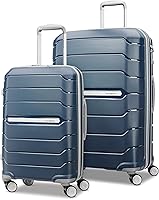
The Samsonite Freeform 2-Piece Luggage Set includes a carry-on and a large checked case. Their outside dimensions, including wheels, are 23 x 15 x 10 in and 31.1 x 20.9 x 13.8 in, respectively.
How many pieces should a luggage set have?
Choose a 2-piece set if you need a carry-on and one checked size; choose 3 pieces if you’ll use a carry-on, medium and large case. The right count depends on how often your packing needs change.
A 2-piece set means fewer cases to store and keeps the choice simple. It works well when you rely on one cabin bag for short trips and a larger suitcase for longer ones.
A 3-piece set gives you more size options, but it also means storing more luggage. Check whether the medium case fills a gap between your carry-on and large case before treating it as a useful extra.
The Samsonite Omni 2 3-Piece Luggage Set includes a global carry-on, a medium checked case and a large checked case. Confirm that the carry-on fits your airline’s limits before you fly.
For international trips, a smaller cabin case may matter more than an extra checked size. Our luggage sets for international travel guide can help you compare that use case.
Which suitcase sizes should your set include?
A useful set usually covers the trips you take most: a carry-on for shorter trips and checked luggage for longer ones. If you want more flexibility, add a medium case between those sizes.
The terms “carry-on,” “medium” and “large” aren’t enough to confirm a fit. Check each case’s measurements against the airline’s cabin rules, your packing space and the route from your door to your car or transit.
A 3-piece set doesn’t guarantee that its carry-on works for every airline. Check the baggage allowance and size limits for your trip before choosing a case.
The Amazon Basics 3-Piece Hardside Luggage Set has outside dimensions that include wheels. They measure 14.8 x 10 x 21.7 in for the carry-on, 17.8 x 11.3 x 26.8 in for the medium and 20.7 x 12.6 x 30.7 in for the large.
Our standard luggage sizes guide explains common carry-on, medium and large size ranges. Read IATA’s baggage guidance, then confirm the exact limits with your airline.
Is a carry-on enough for your short trips?
A carry-on is often enough for a short trip if your clothes and essentials fit within its space. It can also help you avoid checking a bag, when your airline and fare allow you to bring one aboard.
Look at the case’s outside height, width and depth, not only its name or interior packing size. Check how your airline measures bags, including wheels and handles.
If you want to travel with just one case, read our carry-on luggage buying guide. It covers the features to compare when you don’t need a full set.
When does a medium case make a good luggage set more useful?
A medium checked case can fill the space between a carry-on and a large suitcase. It’s a useful option if your carry-on is too small for some trips but you rarely need the largest case.
The American Tourister Westridge 3-Piece Set includes a 20 in carry-on, 24 in medium case and 28 in large case. These are size labels; the cases have ABS shells and expansion.
Think about how often you’d choose the medium case over the other two. If you’d always use the carry-on or the large suitcase, a 2-piece set may suit you better.
How do you compare the cases in a set?
Compare the outside dimensions, materials, wheels, expansion and interior organization for every case you expect to use. A set should give you useful options across your trips, with a purpose for each piece.
Check whether the dimensions include wheels, then look for the same detail on all the cases. Get clear outside measurements for any case whose fit matters to your trip.
The shell material is another point to compare. The Omni 2 has a polycarbonate shell, while the Amazon Basics and Westridge sets use ABS; see hardside vs softside luggage for broader trade-offs.
Wheel style is another feature to compare for stations and airports. All 4 sets here use spinner wheels, and our guide to what spinner luggage is explains how 4-wheel spinners differ from 2-wheel cases.
Expansion and interior pockets give you more packing options, but they don’t replace choosing the right case size. Check which cases expand and what organizing features each one has, rather than assuming every piece shares the same features.
How much storage space will a set need?
A luggage set needs storage space for every case, including the pieces you don’t take on most trips. Before choosing 3 pieces, measure the closet, shelf or room where you plan to keep them.
Compare the largest case’s outside dimensions with your under-bed space or shelf. Check whether the exact cases nest inside one another before counting on that storage option.
Also consider whether you can lift and move the cases where you’ll use them. A large checked suitcase can be awkward on stairs or in a small car, even when it has wheels.
Which kind of luggage set fits your travel pattern?
The best luggage set for you is the smallest set that covers your trips. Match the sizes to your usual packing needs, then compare features that matter for how you travel.
- Mostly short trips: A carry-on may cover your needs. If you want a set, choose one that pairs it with a checked size you’ll use.
- Trips of mixed lengths: A 3-piece set with carry-on, medium and large cases gives you more choices.
- Mostly long trips: Make sure the large checked case has enough room for your packing needs, and check its outside dimensions and weight.
- International flights: Confirm cabin size limits for the airlines and routes you use. See our guide to carry-on luggage size.
If you travel with a partner or family, consider who will use each case and how many bags you can manage. A larger set can help when you need several sizes, but it also means storing more cases.
How to choose a luggage set: a quick checklist
Choose a set by checking your trip needs and each case’s dimensions, then the features you’ll use. A simple list can help you compare sets without getting distracted by the piece count.
- List your common trip lengths and how much you pack.
- Decide if a carry-on alone, a 2-piece pairing or 3 graduated sizes fits those trips.
- Check the outside dimensions of each case against airline rules and your storage space.
- Compare materials, wheels, expansion and interior organization across the pieces.
- Skip sizes you’re unlikely to use, even if they make a set look like a better deal.
For the carry-on, check the rules for each airline you fly. For checked cases, consider whether the large size fits your storage space and the way you travel.
Which luggage set should you choose?
A good luggage set has 2 pieces if you mainly use a carry-on and large checked case, or 3 if you’ll regularly use a medium case too. Compare dimensions with airline limits and storage space before you pick.
The Samsonite Freeform 2-Piece Luggage Set covers the 2-size option; the other 3 sets add a medium checked case. Use our best luggage sets guide to compare options once you know which sizes you need.
Frequently asked questions
What is a good luggage set for one person?
A 2-piece set with a carry-on and a large checked bag is a practical starting point for one person who takes short and longer trips. If you mostly use a carry-on, skip the set; choose 3 pieces only if you’ll use the medium and large cases.
Is a 3-piece luggage set better than a 2-piece set?
A 3-piece set is better if you’ll use a carry-on, medium checked case and large checked case for different trips. A 2-piece set can be a better fit if you only need a cabin bag and one checked size, with fewer cases to store.
What sizes should a luggage set include?
A useful luggage set pairs a carry-on with one or two checked cases, depending on how much you pack and how long you travel. Compare each case’s outside measurements with your airline’s rules and your storage space before deciding whether you need both medium and large sizes.
Should I buy a hardside or softside luggage set?
Choose a hardside or softside luggage set based on the shape and features that suit your packing habits. Hardside cases have a firm shell, while softside cases can have exterior pockets; compare materials, expansion, handles, wheels and interior organization before choosing the set you’ll use.